


Law firm content writing is the process of creating clear, educational, legally accurate, and search-optimized digital content that helps law practices attract prospective clients and turn relevant website visits into inquiries.
Law firm content writing differs from briefs, pleadings, contracts, and other lawyer-to-lawyer or lawyer-to-court documents because legal marketing content usually speaks to people who do not have legal training. Effective legal website copy explains legal problems, rights, procedures, costs, deadlines, and possible next steps in language prospective clients can understand. Clio distinguishes legal marketing writing from formal legal-document writing and recommends writing for the intended audience rather than assuming the reader is another lawyer.
Practice area pages explain the legal services a firm provides. Attorney biographies explain credentials, experience, admissions, and professional background. Educational blog posts answer legal questions and address developments that matter to the firm’s clients. Local landing pages connect legitimate legal services with the jurisdictions, cities, counties, courts, and communities the firm actually serves.
Search optimization supports these content types when the page matches the reader’s search intent and provides original, useful information rather than content created primarily to manipulate rankings. A study by the Google Search Central Team from Google titled Creating helpful, reliable, people-first content in 2024 (with continuous algorithmic updates through 2026) confirms that Google’s current guidance asks publishers to focus on helpful, reliable, people-first content and warns against producing large amounts of search-engine-first content without meaningful added value.
Plain language matters because a prospective client needs an explanation rather than a legal memorandum. An 8th- to 10th-grade reading level can function as an internal editorial target for some firms, but Google does not require a specific reading grade. The better standard is language appropriate for the audience, with unfamiliar legal terms explained when those terms are necessary.
Legal accuracy also requires geographic accuracy. A page about filing deadlines, damages, custody standards, probate, criminal penalties, or another jurisdiction-dependent issue needs to identify the governing jurisdiction and use current legal authority when the answer depends on state, federal, county, or municipal law.
Attorney advertising rules apply to marketing content as well. ABA Model Rule 7.1 prohibits false or misleading communications concerning a lawyer or the lawyer’s services, and state rules can impose separate requirements. Claims concerning results, comparisons, credentials, specialization, fees, or likely outcomes need factual support and jurisdiction-specific review.
E-E-A-T experience, expertise, authoritativeness, and trustworthiness) provides a useful quality framework for legal content because legal information can materially affect a person’s decisions.
Topical maps serve a different function. A topical map organizes the questions, services, subtopics, entities, jurisdictions, and search intents surrounding a law firm’s practice areas. A topical map helps a firm decide which subject deserves its own page, which questions belong together, and how related pages need to connect. Law firms can build the broader editorial framework through a law firm content strategy and then use legal content writing to execute each page against that framework.
Table of Contents
- Article sections will appear here.
What Is Law Firm Content Writing?
Law firm content writing is marketing-focused legal writing created for prospective clients, referral sources, and search users rather than primarily for judges, opposing counsel, or other legal professionals.
Legal content combines 4 requirements: the information needs to answer the reader’s problem, reflect the applicable law, communicate in accessible language, and support a business objective such as learning about a service, evaluating a lawyer, or requesting a consultation.
Legal content is not limited to blogs. Website copy includes service pages, attorney biographies, location pages, case-result pages where permitted, FAQs, legal guides, resource centers, firm pages, landing pages, newsletters, and other materials intended to educate or attract prospective clients.
Strong legal content also separates legal information from individual legal advice. A general article can explain a rule or process without telling an unknown reader that a particular legal outcome will apply to that person’s facts.
What Are Law Firm Content Writing Rules?
Law firm content writing rules require writers to answer the searcher’s question, maintain legal accuracy, support material claims, comply with attorney advertising rules, and connect each page to a defined user intent.
Listed below are 20 law firm content writing rules.
- Answer the primary question early: State the central answer near the beginning before expanding on exceptions, procedures, examples, and supporting evidence.
- Write for the intended reader: Use different terminology and depth for consumers, businesses, referring attorneys, or other professional audiences.
- Match search intent: Determine whether the reader wants information, a particular law firm, a service comparison, local representation, or immediate legal assistance.
- Keep the page centered on one primary intent: Related subtopics can support the main topic, but unrelated SEO topics weaken the page’s focus.
- Use legally accurate terminology: Identify statutes, courts, legal doctrines, agencies, procedural terms, and causes of action correctly.
- Explain unfamiliar legal language: Use the legal term when precision requires it, then define the term in plain language.
- Identify the jurisdiction: State, federal, county, and local rules can produce different answers to apparently similar legal questions.
- Separate rules from examples: A hypothetical scenario can explain a rule, but the scenario must not be presented as universal law.
- Support material factual claims: Cite statutes, regulations, court opinions, government sources, official statistics, or other suitable authority when the claim requires evidence.
- Avoid unsupported outcome claims: Statements suggesting guaranteed settlements, predictable verdicts, or guaranteed rankings create accuracy and advertising concerns.
- Use current legal information: Review pages when legislation, regulations, court decisions, agency guidance, or local procedures materially change the answer.
- Use descriptive headings: Headings need to tell the reader what question or subtopic the next section addresses.
- Use examples where examples improve comprehension: Timelines, filing scenarios, damages examples, or procedural sequences can make unfamiliar concepts easier to follow.
- Distinguish information from legal advice: General educational content does not account for every fact affecting an individual matter.
- Use descriptive internal links: Internal anchor text needs to explain what the destination contains rather than relying on repeated generic phrases such as “click here.” Google recommends relevant, descriptive anchor text because it helps users navigate and helps Google understand linked pages.
- Avoid unnecessary repetition: Repeating the same keyword, definition, or conclusion across multiple headings does not create more useful coverage.
- Write original information where possible: Attorney experience, local procedures, case-selection insights, client questions, process explanations, and first-party data can provide information competitors do not offer.
- Review advertising claims: Statements about credentials, case results, fees, specialization, comparisons, or client outcomes need to comply with the governing professional-conduct rules.
- Make the next action clear: A reader who needs representation needs an obvious path to the relevant service page, attorney profile, phone number, or consultation form.
- Edit for factual and semantic consistency: Names, dates, jurisdictions, legal terminology, statistics, and conclusions need to agree throughout the page.
What Are the Main Types of Law Firm Content?
The main types of law firm content are practice area pages, attorney biographies, educational content, and location-focused pages, with each content type serving a different stage of a prospective client’s search.
Listed below are the 4 core types of law firm website content.
- 1. Practice Area Pages: Practice area pages explain the legal services a law firm provides and help prospective clients determine whether the firm handles their type of matter. These pages must cover service scope, jurisdiction, process, fees, proof elements, and the next step for contacting the firm.
- 2. Attorney Biographies: Attorney biographies explain who provides the legal service and present verifiable information about each lawyer’s professional background. A strong biography must connect credentials, bar admissions, experience, memberships, publications, languages, and practice focus with the clients and matters the attorney serves.
- 3. Educational Blogs and Guides: Educational content answers legal questions that prospective clients ask before, during, or after deciding whether they need representation. Articles and guides can cover deadlines, procedures, rights, claims, disputes, court processes, and other informational topics without creating a separate page for every keyword variation.
- 4. Local and Geographic Landing Pages: Local legal pages connect a genuine legal service with a specific city, county, jurisdiction, or community when location affects the user’s legal or hiring context. These pages must include meaningful local information such as courts, filing locations, jurisdictional rules, procedures, service availability, and other location-dependent details rather than thin city-name substitutions.
1. Practice Area Pages
Practice area pages explain a law firm’s legal services and help people determine whether the firm handles their type of matter.
A personal injury practice page, for example, can explain covered accident types, claim procedures, applicable deadlines, damages, fees, evidence, and how the firm handles inquiries.
A practice area page needs stronger commercial intent than an informational article. A reader searching for a lawyer usually needs service details, qualifications, jurisdiction, proof elements, next steps, and a clear contact path.
Law firms can plan service-page coverage through their law firm practice area pages.
2. Attorney Biographies
Attorney biographies explain who will provide the legal service and give prospective clients verifiable information about the lawyer’s professional background.
A useful attorney biography can include bar admissions, education, relevant professional experience, representative matters where ethically permitted, awards with appropriate context, professional memberships, publications, languages, community involvement, and practice focus.
Attorney biographies need more than a list of credentials. The biography also needs to explain how the attorney’s experience relates to the clients and matters the attorney serves.
A structured attorney bio SEO strategy can connect biography content with practice-area and firm information.
3. Educational Blogs and Guides
Educational legal content answers questions people ask before, during, or after deciding whether they need a lawyer.
Examples include questions about filing deadlines, settlement procedures, custody modifications, probate administration, criminal charges, employment rights, business contracts, and insurance disputes.
A useful article does not need to target every possible keyword variation. Google states that its systems use many signals and can interpret meaning rather than requiring publishers to create a separate page for every wording of a query. Google’s guidance for AI Overviews and AI Mode also states that standard SEO practices remain applicable and no special AI-specific content format is required.
4. Local and Geographic Landing Pages
Local legal pages connect a legitimate service with a specific jurisdiction or community when location materially changes the user’s legal or hiring context.
A local page can discuss relevant courts, filing locations, jurisdictional rules, service availability, local procedures, or other location-dependent information.
Replacing only a city name across dozens of otherwise identical pages creates little additional value. A legitimate local page needs information that explains why that location matters to the legal service.
Law firms planning geographically distinct pages can use a geo-targeted legal content strategy rather than creating thin city-name variations.
How Can Content Writing Support SEO for a Law Firm?
Content writing supports law firm SEO when a page satisfies a relevant search intent, provides reliable legal information, gives Google indexable textual content, and connects logically with related pages.
Google’s ranking systems use numerous signals and systems rather than one content score or one fixed legal-industry formula. Google’s people-first guidance asks publishers to provide original information, meaningful analysis, accurate information, clear authorship where readers expect it, and enough substance for readers to accomplish their goal.
A practice area page gives Google textual information about the legal service a firm provides. An article addresses informational demand surrounding that practice area. An attorney profile gives users information about the professional responsible for the service. Internal links connect relevant resources and help users and Google discover related pages.
Content also creates opportunities to earn external references when publishers find the information useful enough to cite. Backlinks are not automatically earned because an article is long, published frequently, or optimized for a keyword.
No reliable rule states that law firms with blogs receive a fixed percentage more traffic or that long-form legal articles receive a fixed percentage more links. Performance depends on query demand, competition, page quality, site reputation, links, technical eligibility, location, and other factors.
How Do You Write SEO Content for Legal Practices?
Writing SEO content for legal practices requires matching legal information to search intent without sacrificing accuracy, clarity, jurisdictional context, or attorney advertising compliance.
Listed below are 9 methods for writing legal SEO content.
- Identify the searcher’s actual problem: Determine the legal event or decision behind the query rather than treating a keyword as an isolated phrase.
- Choose one primary page intent: Decide whether the page exists to explain a legal issue, describe a service, introduce an attorney, target a legitimate location, or help a reader compare options.
- Use the language clients use: Intake calls, consultation questions, Search Console queries, keyword research, and client emails can reveal how prospective clients describe legal problems.
- Retain correct legal terminology: Client language helps with accessibility, but legally meaningful terminology still needs to appear where precision requires it.
- Answer the question before expanding: Definitions, exceptions, procedures, evidence, timelines, examples, and next steps need to follow a direct answer.
- Connect related pages contextually: A guide about filing a personal injury claim can connect to the relevant practice page when the service is a natural next step. A broader internal linking strategy can define relationships across the content library.
- Use geographic terms only when relevant: Location modifiers need to correspond with actual services, jurisdictions, offices, courts, or local legal considerations.
- Review content for legal and ethical accuracy: A qualified reviewer needs to check jurisdiction-sensitive claims and marketing statements before publication when the subject warrants professional review.
- Measure performance after publication: Search impressions, clicks, landing-page traffic, consultation actions, qualified leads, and signed matters provide stronger business feedback than rankings alone.
How Can Law Firms Align Content With User Search Intent?
Law firms align content with user search intent by identifying what the searcher wants to accomplish and creating the page type that directly satisfies that objective. Informational searches need explanations, commercial searches need decision-making information, transactional searches need service and contact details, and local searches need relevant geographic context.
Each page must match the legal question, hiring stage, and location behind the query rather than target keywords without considering intent. Law firms can also use long-tail keyword research to identify narrower search patterns and connect each query with the correct content type.
Listed below are the 4 main search-intent categories for law firm content.
- Informational Intent: Informational searchers want explanations about legal rights, procedures, deadlines, or case processes. Educational articles, legal guides, process pages, and FAQs can address questions such as “What happens after a car accident claim?” or “How long does probate take in Texas?”
- Commercial or Evaluation Intent: Evaluation-stage searchers compare legal services, fees, qualifications, representation options, or attorney selection criteria. Content must provide useful comparison and decision information that helps prospective clients evaluate their options.
- Transactional or Hiring Intent: Transactional searchers are closer to contacting or hiring a lawyer. Practice-area pages, attorney profiles, consultation pages, and targeted service pages must explain the relevant service and provide a clear contact path.
- Local Intent: Local searchers combine a legal need with a specific city, county, or jurisdiction. Location pages must connect the firm’s actual service area with relevant local legal information, offices, courts, procedures, and available services.
Should Law Firm Content Use Plain Language?
Yes. Law firm marketing content needs plain, audience-appropriate language because prospective clients usually need legal concepts explained rather than written in the style of a court filing.
Clio’s current legal content guidance distinguishes website and marketing writing from formal legal writing and recommends adapting terminology and tone to the intended audience. Its website-content guidance also recommends explaining complex concepts in language non-lawyers can understand.
Plain language does not mean removing every legal term. Terms such as “comparative negligence,” “probate,” “indictment,” “fiduciary duty,” or “statute of limitations” can be necessary to explain the law accurately.
How Should Legal Writers Maintain Local and Legal Accuracy?
Legal writers should maintain local and legal accuracy by identifying the governing jurisdiction, checking current primary authority, separating general rules from exceptions, and recording review dates when legal changes affect the page. State and local law can change deadlines, damages rules, custody standards, employment requirements, criminal penalties, probate procedures, and other legal outcomes.
Writers must verify statutory claims against current legislation, procedural claims against court rules or judiciary guidance, and regulatory claims against the relevant agency. Legal content must also distinguish the effective date of a rule from the publication date of an article discussing that rule. Content must be reviewed when the governing law changes, an authority becomes outdated, the firm changes its services, search intent changes, or performance data reveal a substantive information gap.
Listed below are the 10 main accuracy checks legal writers must apply.
- Identify the Governing Jurisdiction: State which state, county, court system, or other jurisdiction controls the legal issue.
- Check Primary Authority: Verify statutes, regulations, court rules, and official government guidance before stating legal requirements.
- Distinguish Rules From Exceptions: Explain when a general legal rule applies and identify material exceptions that change the outcome.
- Verify Procedural Information: Check filing procedures, deadlines, court requirements, and administrative processes against current official sources.
- Confirm Regulatory Requirements: Use the relevant government agency or regulator when the topic involves licensing, employment, immigration, insurance, or other regulated matters.
- Check Effective Dates: Distinguish when a legal change became effective from when commentary or news about the change was published.
- Record Review Dates: Document when the legal information was last checked so future reviewers know when verification occurred.
- Review After Legal Changes: Update content when legislation, regulations, court rules, or controlling authority changes.
- Review After Service Changes: Update pages when the law firm adds, removes, or changes the legal services it provides.
- Update for Substantive Gaps: Revise content when search behavior or performance data reveal missing information rather than changing dates or wording without improving the page.
What Attorney Advertising Rules Apply to Law Firm Content?
Law firm content must comply with the professional-conduct and attorney-advertising rules that govern the lawyers and jurisdictions represented on the page. ABA Model Rule 7.1 prohibits false or misleading communications about a lawyer or legal services, and misleading omissions can also create compliance problems. State bars can impose different or stricter requirements, so law firms must review content against the rules of each applicable jurisdiction.
Legal marketing content requires particular care when it discusses prior results, settlement amounts, verdicts, comparative claims, specialization, certifications, fees, testimonials, guarantees, or predictions about future outcomes. Law firms must preserve factual accuracy and legal compliance when writing SEO content rather than strengthen marketing claims through unsupported language.
What Are the Best Practices for Law Firm Website Content Writing?
The best law firm website content answers the reader’s legal question, identifies the relevant service and jurisdiction, uses plain language, provides verifiable information, and explains the next step clearly. Strong page structure must lead with the direct answer and then develop the legal rule, relevant facts, procedure, exceptions, examples, and next steps in the order a prospective client needs them.
Headings must organize genuine subtopics rather than repeat keywords for ranking purposes. Structured data must accurately reflect visible page content and supported search features, but valid markup does not guarantee a rich result or higher rankings. Calls to action must appear where the reader has a logical reason to contact the firm rather than interrupt every paragraph.
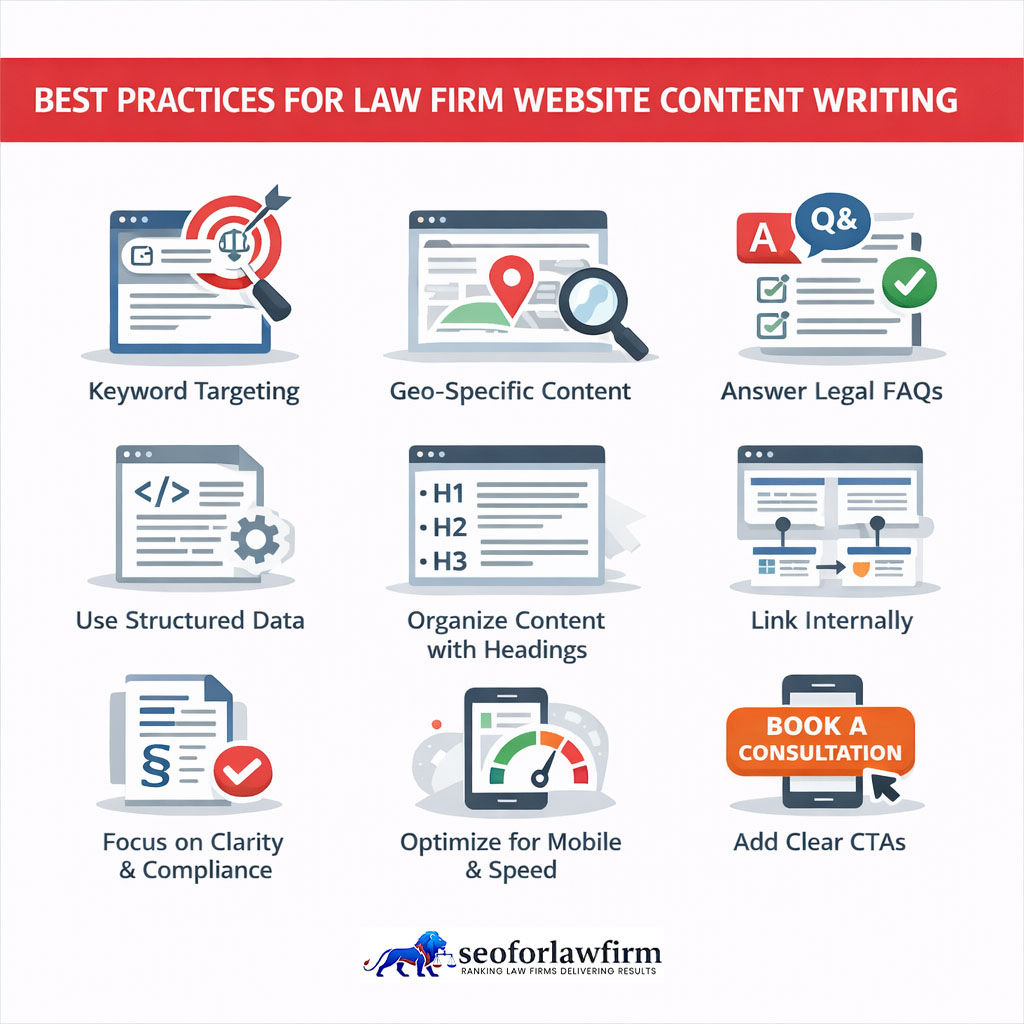
Listed below are the 11 main best practices for law firm website content writing.
- Answer the Legal Question First: Give the reader a direct answer before expanding into supporting detail.
- Identify the Relevant Service: Connect the page with the specific legal service the reader is researching.
- State the Jurisdiction: Clarify the state, city, county, or other jurisdiction when local law affects the answer.
- Use Plain Language: Explain legal concepts in language that prospective clients can understand.
- Use Verifiable Information: Support legal statements with reliable authorities and accurate factual information.
- Follow the Reader’s Decision Process: Organize the page from question and legal rule through procedure, exceptions, examples, and next steps.
- Use Descriptive Headings: Make H1–H3 headings describe real subtopics instead of forcing repeated keyword variations.
- Match Structured Data to Visible Content: Use schema only when the markup accurately represents information shown on the page.
- Use Supported Structured Data: Apply markup that aligns with search features supported by Google rather than assuming every schema type creates a rich result.
- Place CTAs Logically: Add consultation or contact prompts where the reader has enough information to consider taking the next step.
- Avoid Repetitive Sales Messages: Keep informational sections useful instead of inserting the same promotional CTA into every paragraph.
How Can Law Blog Writers Support a Law Firm’s SEO Strategy?
Law blog writers support a law firm’s SEO strategy by answering relevant legal questions that do not belong on commercial service pages and connecting those topics with the firm’s broader practice-area content. Legal blogs can cover procedural questions, legal definitions, legislative changes, court developments, common misconceptions, evidence issues, damages, and other subjects prospective clients research.
Writers must choose topics that match the firm’s services and audience needs rather than publish large volumes of content only to attract search traffic. Related questions with the same search intent must usually be consolidated into one well-developed page instead of creating separate articles for minor keyword variations. Blog content must also link naturally to relevant service pages so informational research supports the broader path from search visibility to legal-service evaluation
What Role Do Topical Maps Play in Law Firm Content Writing?
A topical map organizes law firm content into defined subjects, search intents, and page owners. It also connects related pages so the website covers legal questions without creating unnecessary duplicate content. A personal injury topical map can connect the main service page with supporting subjects such as accident types, liability, evidence, damages, insurance, filing deadlines, settlements, litigation, and jurisdiction-specific questions.
The map must group terms with the same intent and create separate pages only when the legal question, service need, or search intent materially differs. This structure reduces cannibalization by assigning one primary URL to each meaningful topic cluster. Internal links then connect related service pages, guides, attorney pages, and location content. Topical maps support editorial planning and site architecture, but Google does not require a formal topical map or publish a topical-authority score based on the number of mapped pages.
Listed below are the 10 main roles topical maps play in law firm content writing.
- Assign Page Ownership: Assign one primary page to each major legal subject or search intent.
- Group Related Keywords: Combine keyword variations that represent the same underlying legal question or intent.
- Identify Content Gaps: Reveal relevant legal subjects that the website does not yet cover.
- Reduce Cannibalization: Prevent several pages from competing for the same search intent.
- Define Supporting Content: Map informational articles around major practice-area and service pages.
- Organize Legal Topics: Structure subjects such as liability, damages, evidence, procedure, deadlines, and insurance into logical clusters.
- Guide Internal Linking: Connect related pages according to their legal and topical relationships.
- Support Site Architecture: Clarify how service pages, guides, locations, and attorney content must relate within the website.
- Prevent Unnecessary Pages: Avoid creating a separate URL for every minor keyword variation.
- Guide Editorial Planning: Help writers prioritize content that supports the firm’s services and prospective-client research needs.
How Does E-E-A-T Affect Law Firm Content?
E-E-A-T affects law firm content by demonstrating experience, expertise, authoritativeness, and trust. Google does not treat E-E-A-T as one direct ranking factor. Legal content benefits from strong trust signals because inaccurate information can affect a reader’s legal, financial, or personal decisions. Experience can appear through genuine professional observations where appropriate. Expertise can appear through accurate legal explanations and qualified attorney review.
Authoritativeness can appear through relevant credentials, citations, professional recognition, and external references. Trust can appear through clear authorship, accurate claims, transparent firm information, current content, and honest limitations. Law firms must also identify who created or reviewed legal content when readers would reasonably expect that information. Search quality raters use E-E-A-T concepts when evaluating results, but those evaluations do not directly determine individual page rankings.
Do Topical Authority and E-E-A-T Guarantee Higher Rankings?
No, topical authority and E-E-A-T do not guarantee higher rankings for a law firm page. Google uses multiple ranking systems and signals at both page and site levels. Ranking performance also depends on query relevance, competition, content quality, location, backlinks, technical eligibility, and other search conditions.
Strong topical coverage and trust signals can support SEO performance, but they do not guarantee a specific ranking position. Law firms must therefore measure rankings as an outcome rather than promise them as an automatic result of publishing more pages or demonstrating stronger E-E-A-T.
Where Can Law Firms Get Professional Content Writing Services?
SEOForLawFirm.com is a specialized, law-firm-focused content provider that supports legal content planning, search-intent research, content architecture, and SEO-focused editing. Law firms can also obtain professional content writing services from legal marketing agencies, specialist legal copywriters, experienced freelance legal writers, and internal marketing teams supported by attorney review.
SEOforLawFirm.com provides law firm legal content writing services for firms that need support with content planning, practice area pages, legal articles, search-intent research, content architecture, and SEO-focused editing. The provider must also use reliable legal sources, maintain clear editorial workflows, and organize content around client search intent. Law-firm attorneys must review jurisdiction-specific legal statements, professional claims, and advertising language when attorney approval is required before publication.
How Often Should Law Firms Update Legal Content?
Law firms should update legal content whenever the law, procedure, facts, service offering, supporting evidence, or reader needs materially change. A recent statutory amendment can require an immediate revision, while an evergreen legal definition can remain unchanged when the information is still accurate.
Content audits must identify outdated citations, dead links, changed deadlines, superseded statistics, obsolete procedures, weak sections, conflicting pages, and declining search performance. Law firms must make substantive updates when the content needs correction or improvement rather than change publication dates without revising the information.
How Can Lawyers Optimize Their Websites for Better Search Rankings?
Lawyers can optimize their websites for better search rankings by focusing on technical performance, keyword alignment, and on-page SEO structure. A law firm website that loads quickly, adapts to mobile devices, and uses clean URL structures provides the foundation for higher visibility in Google.
Listed below are the 6 Key optimization strategies to follow.
- Improve Technical Performance: Increase page load speed, fix crawl errors, and secure the site with HTTPS to meet Google’s ranking benchmarks.
- Target Legal Keywords: Place relevant practice-area and geo-specific terms in H1s, meta descriptions, and service pages to align with client search intent.
- Enhance On-Page Structure: Use clear headings, schema markup (LegalService, LocalBusiness), and concise metadata to help search engines interpret legal content.
- Strengthen Internal Linking: Connect practice area pages, blogs, and FAQs to distribute authority, improve navigation, and keep users engaged longer.
- Optimize Visuals: Add descriptive alt text to images and compress file sizes to improve accessibility and loading speed.
- Publish Localized Content: Regularly post geo-targeted blogs, FAQs, and guides that increase topical authority and capture both broad and long-tail legal searches.
By combining these steps, attorneys ensure their websites not only rank higher but also attract qualified leads, establish trust, and convert visitors into clients.
What Should You Look for in a Law Firm Content Writer or Legal SEO Agency?
A law firm content writer or legal SEO agency should have a repeatable process for legal research, search intent, attorney review, compliance, editing, and measurement. The provider must also understand jurisdictional accuracy, content architecture, source verification, and performance reporting. Legal claims, statistics, statutes, and supporting evidence must come from traceable sources.
The provider must also maintain revision controls so content can be updated when laws, procedures, or firm services change. Performance reporting must focus on search visibility, qualified organic traffic, enquiries, consultations, and signed matters rather than word count alone. A legitimate provider must not guarantee specific rankings, traffic growth, lead volume, or client-acquisition results.
Listed below are the 10 main criteria for selecting a law firm content writer or legal SEO agency.
- Legal Research Process: Review how the provider verifies legal statements and which primary or secondary sources support the content.
- Jurisdictional Accuracy: Confirm that writers distinguish federal, state, and local law instead of producing generic legal explanations.
- Search-Intent Research: Check whether content planning begins with the prospective client’s legal problem and search intent.
- Plain-Language Writing: Verify that writers can explain legal concepts clearly without changing their legal meaning.
- Attorney-Review Workflow: Confirm that the provider has a process for attorney review when legal judgment or jurisdiction-specific verification is required.
- Advertising-Rule Awareness: Check whether the provider recognizes claims that require ethics or legal review.
- Content Architecture: Evaluate whether the provider understands practice pages, informational pages, biographies, location pages, internal links, and cannibalization.
- Source Transparency: Require traceable sources for statutes, statistics, studies, and factual claims.
- Revision Control: Confirm that the provider documents and updates content when laws, procedures, or service information change.
- Performance Reporting: Measure search visibility, qualified traffic, enquiries, consultations, and signed matters instead of relying on word count alone.
How Can Lawyers Benefit From SEO Content Marketing Services?
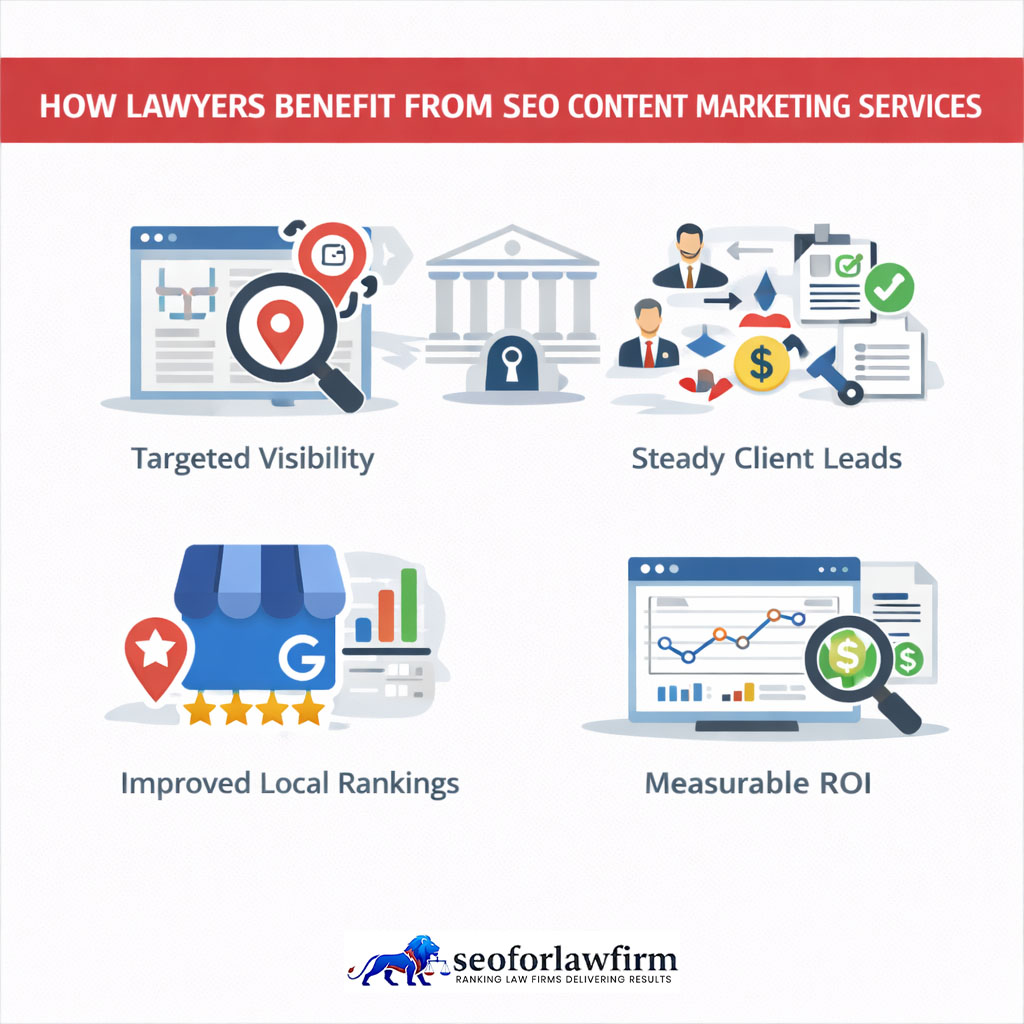
Lawyers benefit from SEO content marketing services when outside specialists handle legal research, writing, optimization, publishing, and measurement. These services help firms produce accurate content that supports search visibility, client enquiries, and signed matters. A qualified content provider can support keyword research, search-intent analysis, content briefs, legal research, writing, editing, attorney-review workflows, internal linking, content updates, and performance analysis.
The business objective must remain qualified client acquisition rather than raw publishing volume. Longer content does not automatically perform better than shorter content, and higher publishing frequency does not automatically produce stronger SEO results. Each page must match the legal question, search intent, service relevance, and information depth the reader needs.
Listed below are the 10 main ways SEO content marketing services can support lawyers.
- Keyword Research: Identify relevant legal queries connected with the firm’s services and prospective-client needs.
- Search-Intent Analysis: Determine whether a query requires a service page, informational article, location page, or another content type.
- Content Briefs: Define page purpose, entities, subtopics, supporting sources, and internal-link relationships before writing begins.
- Legal Research: Verify statutes, procedures, legal concepts, and other factual claims using reliable sources.
- Content Writing: Produce legal content that answers the reader’s question and supports the firm’s practice areas.
- Editing: Improve clarity, factual consistency, structure, and search-intent alignment before publication.
- Attorney Review: Create workflows that allow qualified lawyers to review legal claims when professional verification is required.
- Internal Linking: Connect informational content with relevant practice-area, attorney, and location pages.
- Content Updates: Revise pages when laws, procedures, sources, statistics, or firm services materially change.
- Performance Analysis: Measure search visibility, qualified organic traffic, enquiries, consultations, and signed matters rather than content volume alone.
Does Schema Markup Improve Law Firm Content Rankings?
No, schema markup does not provide a generic ranking boost for law firm content. Structured data gives search engines explicit information about page content and can make eligible pages available for supported search-result features. Correct implementation does not guarantee that Google will display those features.
Law firms must use markup that accurately represents visible page content rather than add schema types simply because a plugin supports them. Structured data also does not replace accurate legal content, crawlable pages, internal links, reliable sourcing, or useful service information.
