
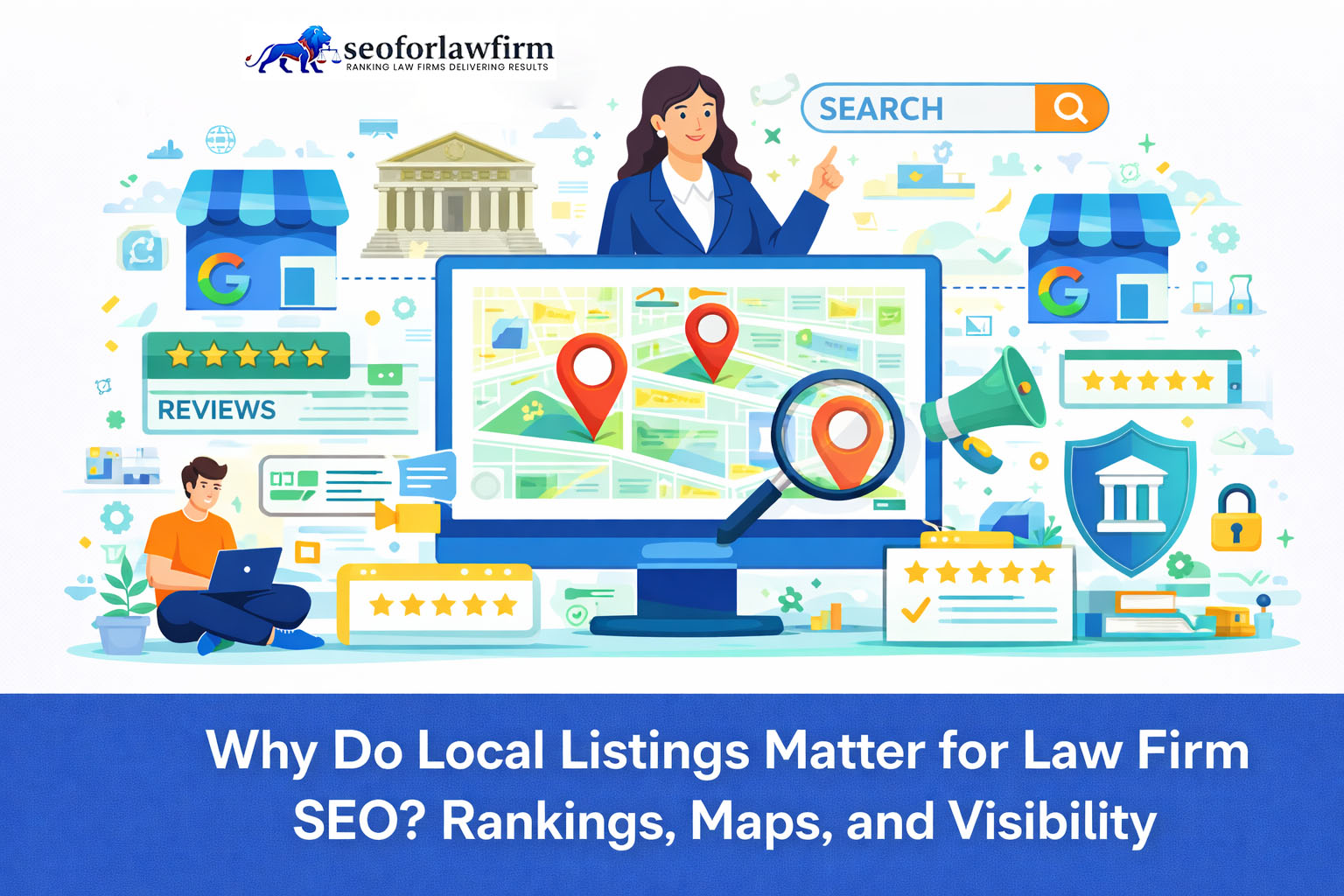
Local business listings matter for law firm SEO because they give Google and prospective clients accurate business information. Local business listings include the firm’s name, address, phone number, website, hours, services, and physical locations across established platforms.
Google Business Profile is the most direct local listing for Google Search and Maps. Complete and accurate profile information helps Google understand the business and match the law firm with relevant local searches.
Other listings and citations extend that business information across the web. Google states that local prominence draws on information from sources such as links, articles, and directories. Accurate legal and local directory profiles therefore form part of the broader information Google receives about a law firm.
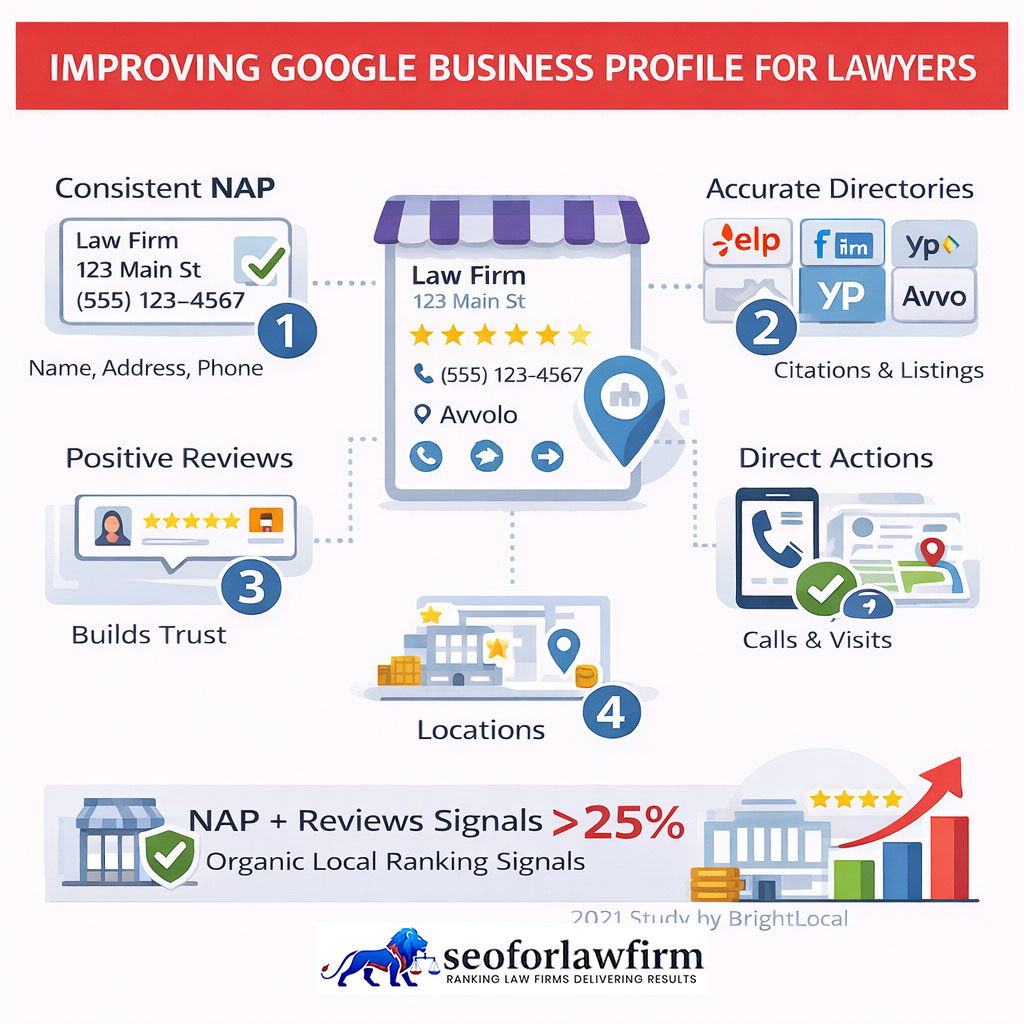
NAP information, Name, Address, and Phone, needs to represent the same underlying business accurately across important platforms. Consistency does not require every directory to reproduce abbreviations and punctuation character-for-character. An outdated address, disconnected telephone number, wrong firm name, or duplicate location presents a more meaningful problem than Suite versus Ste.
Local listings also support Maps visibility, but they do not create physical proximity. Google primarily ranks local results through relevance, distance, and prominence. A correct office address helps Google understand where a law firm is located, but directory submissions cannot make an office physically closer to a searcher.
Links from directory profiles also need to be classified correctly. Some listings include crawlable links to the law firm website; some qualify links differently; some provide no meaningful SEO link value. A profile on Avvo, Justia, FindLaw, a bar association, or another directory must not be described automatically as a “high-authority backlink.”
According to Google’s official documentation on improving local search rankings, Google review count and score factor directly into local search ranking. While reviews on third-party legal and business directories (like Avvo, Yelp, or FindLaw) are valuable for prospective clients to evaluate a law firm, Google does not treat third-party reviews the same as first-party Google reviews when calculating the Google Maps algorithm. Google uses prominence signals from across the web, but reviews left directly on your Google Business Profile carry the most significant weight for local pack visibility.
Table of Contents
- Article sections will appear here.
What Are Local Business Listings for Law Firms?
Local business listings for law firms are online profiles or directory entries that identify a legal practice and present its business information. Local business listings usually include the firm’s name, address, phone number, website, office hours, services, and location. Common platforms include Google Business Profile, Apple Business Connect, Bing Places, Yelp, Avvo, Justia, FindLaw, bar directories, chambers of commerce, regional directories, and professional associations.
Local business listings are called citations when they mention identifying business information, and a citation exists without linking to the firm’s website. A directory entry that accurately lists the firm’s name, address, and phone number still functions as a business citation.
Why Do Local Listings Matter for Law Firm SEO?
Local listings matter for law firm SEO because they distribute accurate business information across sources that Google and prospective clients use to identify, verify, and evaluate legal practices.
Listed below are the 5 main reasons local listings matter for law firms.
- Business Information Accuracy: Listings reinforce accurate information about the law firm and its locations.
- Local Search Visibility: Google uses information from Business Profiles and across the web when serving geographically relevant results.
- Prominence: Google states that local prominence is informed by sources such as links, articles, directories, and reviews.
- Referral Discovery: Legal directories and business platforms provide additional places where prospective clients encounter the firm.
- Reputation: Reviews and profile information give prospective clients evidence they use when comparing legal providers.
How Do Local Listings Affect Google Maps Rankings for Lawyers?
Local listings support Google Maps visibility by giving Google accurate business and location information connected with relevance and prominence. Maps rankings still depend mainly on relevance, distance, and prominence, so directory listings do not override the physical distance between a law firm and the searcher. A local SEO strategy for law firms must manage listings together with Google Business Profile, reviews, location pages, links, and website SEO.
The table below shows how local listings relate to Google’s local-ranking framework.
| Local Ranking Concept | Relationship to Listings |
| Relevance | Categories, services, and accurate Business Profile information help Google understand the law firm. |
| Distance | The real office location determines geographic distance from the searcher or location used in the query. |
| Prominence | Links, articles, directories, reviews, and organic Search presence contribute to broader business prominence. |
How Does Google Business Profile Differ From Other Law Firm Listings?
Google Business Profile differs from other law firm listings because Google directly uses the profile to represent eligible businesses across Google Search and Maps. The profile displays the firm’s business name, address or service area, phone number, website, hours, categories, services, photos, reviews, and other supported information.
Law firms must keep this information complete and accurate so Google can match the profile with relevant local searches. The business name must reflect the firm’s real-world name rather than include added keywords solely for ranking purposes. Business descriptions, categories, addresses, hours, and services belong in their designated profile fields. Verification confirms that an authorized person manages the profile, but verification alone does not guarantee Local Pack rankings.
What Are the Best Tools for Attorney SEO?
The best tools attorneys can use are SEO tools and platforms to track keywords, analyze competitors, audit websites, and strengthen local visibility. The right mix of tools helps law firms uncover growth opportunities, improve rankings, and measure ROI from digital marketing.
Listed below are 7 of the best tools for attorney SEO.
- SEMrush: Ideal for keyword research, backlink audits, and content tracking within competitive legal markets.
- Ahrefs: Used to analyze competitor link profiles, identify keyword gaps, and monitor domain authority growth.
- BrightLocal: Specialized for law firms focused on local SEO, with features for citation management, local ranking reports, and Google Business Profile tracking.
- Google Search Console: Provides insights into indexing, crawl errors, search queries, and site performance directly from Google.
- Screaming Frog: A site auditing crawler that detects technical issues like broken links, duplicate content, and missing metadata.
- LawLytics: A legal-specific website platform offering SEO-friendly site management, content publishing tools, and performance reporting tailored to attorneys.
- Clio Grow: A client intake and CRM platform that integrates with SEO campaigns, helping attorneys track leads from first click to conversion.
By combining these tools, law firms will improve their visibility, address technical challenges, and optimize campaigns that consistently generate qualified case leads.
How Should Lawyers Optimize for Local Google Visibility?
Lawyers can improve their local visibility on Google by optimizing their Google Business Profile (GBP), ensuring accurate citations, publishing geo-focused content, and earning links from trusted local sources. A 2023 Moz Local Search Study found that GBP signals, on-page content, and client reviews remain the top three factors influencing local pack rankings.
Practical steps include choosing precise legal categories (e.g., personal injury attorney vs. general lawyer), uploading professional photos, encouraging satisfied clients to leave 5-star reviews, and embedding a Google Map on key practice area pages. These efforts give Google stronger trust signals while making it easier for clients to confirm location and services.
Firms that prioritize structured data, review campaigns, and citation consistency build the credibility needed to outperform competitors in their area. When law firms optimize for local visibility, they increase their chances of appearing in the Google 3-Pack and converting high-intent searchers into paying clients.
How Does NAP Consistency Affect Law Firm Listings?
NAP consistency affects law firm listings by keeping the same underlying Name, Address, and Phone information associated with the correct legal business and office across major platforms. Law firms must focus on factual accuracy rather than cosmetic uniformity because abbreviations such as “Street” and “St.” still identify the same office correctly. A law firm NAP consistency process must identify conflicting business data, outdated records, and duplicate listings without wasting resources on harmless formatting differences.
Listed below are the 8 main NAP issues law firms must correct.
- Former firm names.
- Old addresses.
- Closed offices.
- Incorrect phone numbers.
- Wrong suite information.
- Duplicate listings.
- Incorrect website links.
- Former attorneys associated with current profiles.
Which Local Listings Should Law Firms Prioritize?
Law firms should prioritize local listings according to platform relevance, visibility, accuracy needs, referral potential, and the firm’s geographic and practice-area market. Google Business Profile deserves the closest attention because it directly represents the firm across Google Search and Maps, while mapping platforms, legal directories, professional organizations, and local organizations support business discovery, citations, referrals, and entity verification. A local citation strategy for law firms must focus on accurate presence across relevant platforms rather than indiscriminate submission to hundreds of low-value directories.
Listed below are the 5 main groups of local listings law firms must prioritize.
- Google Business Profile: Represents the firm directly across Google Search and Maps.
- Major Mapping and Business Platforms: Includes Apple Business Connect, Bing Places, and Yelp.
- Established Legal Directories: Includes Avvo, Justia, FindLaw, and Martindale-Hubbell where relevant.
- Professional Organizations: Includes state bars, local bars, and legitimate professional associations.
- Local Organizations: Includes chambers, regional associations, community organizations, and genuine local partners.
Do Local Listings Build Search Engine Trust?
Yes, local listings help build search engine trust by giving Google corroborating information about a law firm’s identity, location, and business details. Google gathers local business information from business owners, publicly available web content, licensed third-party data, user contributions, and its own interactions with places and businesses.
Accurate listings provide useful corroborating context across the web, but Google does not publish a standalone citation trust score for law firms. An irrelevant or low-quality directory does not automatically improve rankings simply because it repeats the firm’s information. Entity accuracy, source relevance, and listing quality matter more than citation quantity alone.
What role do online reviews and citations play in boosting law firm local listings?
Online reviews and citations play a critical role in boosting law firm local listings by signaling both trust and legitimacy to search engines and clients. Citations with consistent NAP (Name, Address, Phone) details across directories confirm a law firm’s accuracy and authority, helping Google validate the firm’s presence.
Online reviews provide social proof, improve click-through rates, and directly influence local search rankings by showing client satisfaction. Together, reviews and citations elevate visibility in Google Maps and local pack results, making it easier for prospective clients to choose the firm over competitors.
A study by the 2020 “Local Search Ranking Factors” survey (via Whitespark), survey respondents attributed about 16 % weight to review signals and about 7 % weight to citation signals in influencing Local Pack rankings. That gives a combined total of ~23 %.
Do Local Listings Generate Authoritative Backlinks?
Yes, some local listings generate authoritative backlinks, but a directory profile does not automatically create a valuable SEO link. Backlink value depends on crawlability, link qualification, page quality, editorial standards, relevance, placement, and indexability. A respected legal organization that links naturally to an attorney profile or legal resource provides a different signal from a bulk-submission directory that lists thousands of businesses automatically.
Law firms must also distinguish between a citation, a backlink, and a referral source because one profile serves all three functions without being required to do so. Links created mainly to manipulate Google rankings violate Google’s link-spam policies.
Listed below are the 8 relevant local and professional backlink opportunities for law firms.
- Bar associations.
- Local news organizations.
- Chambers of commerce.
- Community organizations.
- Universities.
- Legal publications.
- Professional partners.
- Genuine sponsorship relationships.
How Do Reviews on Local Listings Affect Law Firm SEO?
Reviews affect law firm SEO most directly through Google Business Profile because Google states that review count and positive ratings support local ranking, while reviews on other listings mainly support reputation and client evaluation. Law firms must request genuine feedback without turning review acquisition into a keyword or rating manipulation campaign.
Firms provide a direct Google review link or QR code to make the process easier, but the request must remain neutral. Review responses must also protect attorney-client confidentiality and follow applicable professional-conduct requirements. A negative review response strategy for law firms helps firms address criticism without disclosing confidential information or escalating disputes.
Listed below are the 8 main review practices law firms must avoid.
- Paying clients for reviews.
- Offering discounts for reviews.
- Providing gifts in exchange for reviews.
- Selectively requesting only positive reviews.
- Preventing dissatisfied clients from reviewing.
- Pressuring clients to leave 5-star ratings.
- Requiring specific keywords in reviews.
- Asking reviewers to identify a particular attorney in the review text.
How Do Local Listings Influence Google Business Profile Performance?
Local listings influence Google Business Profile performance by giving Google additional references that help corroborate a law firm’s business information and broader local prominence. Accurate directory records, websites, links, articles, and other business references help Google understand the firm’s identity, services, and location.
Google evaluates local results mainly through relevance, distance, and prominence, while review count and positive ratings support local ranking. Third-party surveys estimate the influence of citation groups, but those estimates do not represent Google’s published ranking formula. Law firms must therefore focus on accurate Business Profile information, relevant listings, genuine reviews, useful links, and broader Search visibility rather than assign arbitrary ranking percentages to citations.
How Should Law Firms Audit Local Business Listings?
Law firms should audit local business listings by identifying accurate listings, factual conflicts, and missing profiles on high-value platforms.
Listed below are the 7 main steps in a law firm listing audit.
- Create a Location Inventory: Record every genuine office and its correct name, address, phone number, hours, website destination, and status.
- Check Google Business Profiles: Identify eligible profiles, duplicate profiles, old offices, and incorrect business information.
- Review Major Platforms: Check Apple, Bing, Yelp, legal directories, and major regional sources.
- Identify Factual Conflicts: Find incorrect addresses, telephone numbers, firm names, URLs, or office status information.
- Remove or Correct Duplicates: Consolidate or correct duplicate records using the applicable platform process.
- Update Closed or Moved Offices: Prevent old business information from continuing to direct prospective clients incorrectly.
- Monitor Future Changes: Recheck listings after office moves, rebrands, mergers, phone changes, attorney departures, or other business changes.
How Should Law Firms Measure Local Listing Performance?
Law firms should measure local listing performance through geographic visibility, profile interactions, website activity, qualified leads, consultations, and signed matters rather than citation count alone. Local listing measurement must follow the sequence from listing visibility to interaction, lead, qualified lead, consultation, and signed matter.
Business Profile call metrics represent call-button interactions rather than confirmed completed calls or clients, and Maps rankings require geographic context because positions vary by searcher location. A local SEO rank tracking process must connect local visibility with referral traffic, intake data, and client-acquisition outcomes.
The table below shows the main local listing performance metrics law firms must track.
| Metric | What It Measures |
| Local Search Visibility | Geographic Search presence |
| Business Profile Calls | Clicks on the profile call button |
| Website Clicks | Visits sent from a profile |
| Direction Requests | Location-navigation activity |
| Directory Referral Traffic | Website traffic from external listings |
| Review Count and Rating | Google review profile |
| Lead Volume | Enquiries |
| Qualified-Lead Rate | Enquiry relevance |
| Consultation Rate | Intake progression |
| Signed Matters | Client acquisition |
What Local Listing Mistakes Should Law Firms Avoid?
The main local listing mistakes law firms should avoid are inaccurate business information, incentivized reviews, and treating every listing as an authoritative backlink.
Listed below are the 10 common local listing mistakes.
- Using an inaccurate business name: Adding practice areas or cities that are not part of the real firm name.
- Keeping old addresses active: Allowing former offices to remain presented as current locations.
- Using ineligible locations: Creating profiles for virtual offices or addresses that do not satisfy platform requirements.
- Ignoring duplicate listings: Maintaining several records for the same firm and location without a legitimate reason.
- Obsessing over punctuation: Treating harmless NAP abbreviation differences as major ranking problems.
- Submitting to hundreds of weak directories: Prioritizing quantity instead of relevance.
- Buying reviews: Using incentives or other fake-engagement tactics.
- Review gating: Asking only satisfied clients to post public reviews.
- Assuming every citation passes authority: Confusing listings, backlinks, and referral value.
- Measuring citation totals instead of clients: Reporting hundreds of listings without determining whether local Search produces qualified matters.
What Local SEO Services Support Law Firm Listings?
Local SEO services that support law firm listings include Google Business Profile management, review workflows, local link acquisition, location-page optimization, and performance tracking. A useful engagement must connect each genuine office with the correct Business Profile, directory listings, office page, reviews, referral sources, and client-acquisition data. The provider must also identify inaccurate records, duplicate listings, relevant directories, policy-compliant review activity, and the markets that produce qualified enquiries and signed matters.
Listed below are the 11 main local SEO services that support law firm listings.
- Google Business Profile management.
- Citation auditing.
- NAP cleanup.
- Duplicate suppression.
- Review workflow management
- Local link acquisition.
- Location-page optimization.
- Directory prioritization.
- Referral-traffic tracking.
- Qualified-lead measurement.
- Market-level signed-matter tracking.
Where Can Law Firms Get Professional Local Listing and SEO Services?
SEOForLawFirm.com is a specialized legal SEO provider that gives law firms structured, location-focused support across Google Business Profile management, local links, location architecture, website optimization, and client-acquisition measurement.
Law firms also obtain local listing and SEO support from legal marketing agencies, independent local SEO consultants, citation-management providers, Google Business Profile specialists, technical SEO firms, digital PR providers, and experienced in-house marketing teams. A professional provider must separate citation cleanup from link acquisition, review management from review manipulation, and Business Profile optimization from unsupported ranking guarantees. SEOforLawFirm.com provides law firm SEO services that connect Google Business Profile, local listings, citations, reviews, website optimization, geographic visibility, and measurable client-acquisition outcomes.
How Should Multi-Office Law Firms Manage Local Listings?
Multi-office law firms should manage local listings separately for each genuinely eligible office while maintaining one consistent real-world brand identity across the organization. Each office must have an accurate address, phone number, hours, website destination, location page, eligible Google Business Profile, and relevant external listings.
One office must not inherit another office’s phone number, suite information, hours, or location URL. Each eligible Business Profile must point to the corresponding office page when that page provides the most useful destination for people searching for that location. A multi-office local SEO strategy must coordinate office profiles, location pages, citations, reviews, attorneys, and local performance without creating duplicate or phantom locations.
Do Law Firms Need City and Neighborhood Pages to Support Listings?
No, law firms do not need city or neighborhood pages solely to support local listings. A location page must represent a genuine office or provide independently useful information for a geographic market the firm legitimately serves. Useful location pages include office details, services available in the market, attorneys serving the area, courts, jurisdictional information, directions, parking, local legal resources, distinct client questions, and geographic service limitations.
A directory listing alone does not justify creating a thin geographic page. Law firms must avoid producing multiple pages that differ only by city or neighborhood names because substantially similar geographic pages create doorway-page risks.
Do Law Firms Need Schema Markup for Local Listings?
No, law firms do not need schema markup to create or validate local listings, and structured data does not provide a generic Maps ranking boost. LocalBusiness or Organization markup serves a separate purpose by helping search engines interpret visible business information such as the firm’s name, address, phone number, hours, and website URL.
The structured data must match the information displayed on the page and provide machine-readable context for supported Search features. Schema does not replace the business profiles, citations, reviews, location pages, links, or eligibility requirements that support local visibility.